◇ Whole-food botanicalPillar 3
Himalayan Tartary Buckwheat
The wild buckwheat that isn't a wheat.
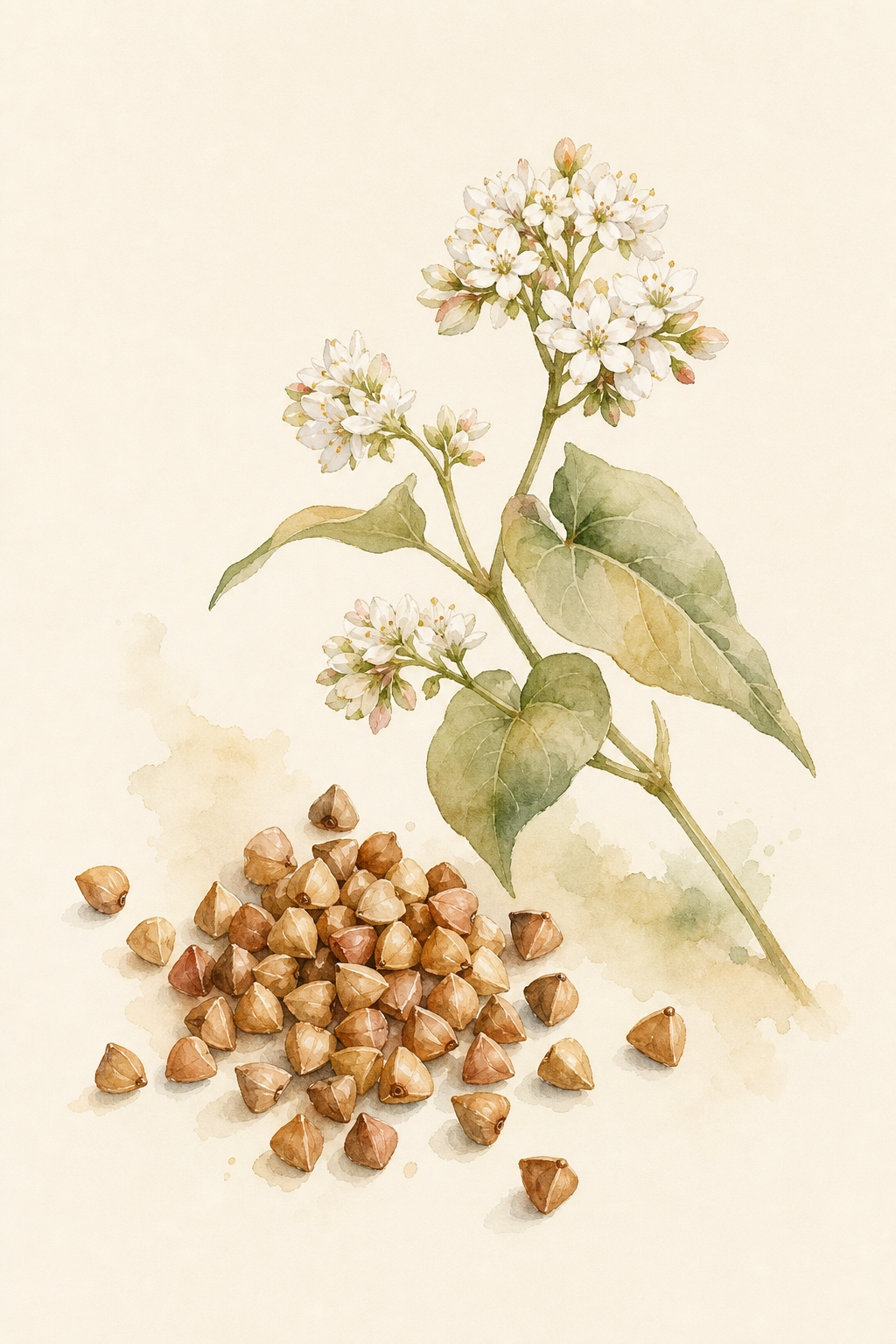
Tartary buckwheat (Fagopyrum tataricum) grown wild at altitude in the Himalayas. A pseudo-cereal — no relation to wheat — and one of the most polyphenol-dense grains studied. Naturally rich in rutin and 2-HOBA (hobamine).
- Botanical name
- Fagopyrum tataricum
- Rutin content
- Up to 400× ordinary buckwheat
- Gluten status
- Naturally gluten-free
- Role
- Pillar 3 — natural source of 2-HOBA
◇ TL;DR
- What: Tartary buckwheat (Fagopyrum tataricum) is a high-altitude pseudo-cereal — not a wheat — grown wild in the Himalayan region.
- Why it's special: Up to 400× the rutin of ordinary common buckwheat, and one of the richest known dietary sources of 2-HOBA (hobamine).
- Gluten: Naturally gluten-free.
- In Beyond Cactus+: The third pillar of the formula. Whole-food source — not an isolated extract.
What "Tartary" buckwheat actually is.
"Buckwheat" is a confusing name. It isn't wheat. It isn't a grain. It's a pseudo-cereal — a flowering plant in the same family as rhubarb and sorrel — and it's been cultivated for roughly four thousand years. The species most people eat is Fagopyrum esculentum, common buckwheat — the basis of soba noodles, Russian kasha, French galettes.
Beyond Cactus+ uses a different species: Fagopyrum tataricum, also called Tartary buckwheat or "bitter buckwheat." It is smaller, more polyphenol- dense, more bitter (which is why it's harder to sell as a mainstream noodle), and historically grown at altitude across the Himalayas, Tibet, parts of Yunnan and Bhutan. It thrives where other crops can't — cold, thin air, harsh soil — and it accumulates polyphenols partly as a stress response to those conditions.
The rutin number — and why it matters.
Tartary buckwheat contains up to 400 times the rutin of ordinary common buckwheat. Rutin (a flavonoid glycoside) is one of the more thoroughly studied plant antioxidants — it's sold as a stand-alone supplement in many markets for vascular and microcirculation support.
We don't quote the 400× number to sell rutin tablets. We quote it because it's a useful proxy for the overall phytochemical density of Himalayan Tartary Buckwheat. A plant that produces that much rutin tends to produce concentrated quercetin, vitexin, and — most relevantly for us — 2-HOBA.
For more on rutin, see the open-access overview on Wikipedia. For the published research on Tartary buckwheat phytochemistry, search "Fagopyrum tataricum" on PubMed.
HTB is also the carrier for 2-HOBA.
The reason we use Himalayan Tartary Buckwheat — and not a cheaper, easier-to-source common buckwheat — is 2-HOBA (hobamine). Hobamine is a small molecule that selectively scavenges isolevuglandins — reactive lipid-oxidation byproducts implicated in chronic inflammation. It's been the subject of two decades of research at Vanderbilt University.
Tartary buckwheat is one of the only known concentrated dietary sources. Common buckwheat doesn't have it in meaningful quantities. That's why the species choice matters.
Whole-food vs. isolated extract — and why we picked whole-food.
We could have used an isolated 2-HOBA extract. We chose not to. Whole-food botanical delivery has three advantages we value:
- Native plant matrix. 2-HOBA arrives in the company of rutin, quercetin, vitexin, fibre and protein — the same chemical neighbourhood your body evolved to absorb it from.
- Conservative dosing. Food-level intake of hobamine sits well within the safety profile established in clinical research, with much wider headroom than concentrated isolates.
- Honest labelling. A whole-food ingredient is transparent. You can hold the box up to the light, read "Himalayan Tartary Buckwheat," and know what's in it. An isolated novel-ingredient extract requires a different regulatory pathway and a different conversation.
What HTB pairs with inside the formula.
Himalayan Tartary Buckwheat is one of three plant pillars in Beyond Cactus+. The other two:
- Mexico cactus (nopal) — the traditional women's-wellness foundation. Soluble fibre, betalain pigments, centuries of use.
- Florac™ 10-plant antioxidant complex — broad-spectrum polyphenol coverage from olive, grape, pomegranate, green tea, grapefruit, bilberry, acerola, broccoli, cranberry and blackcurrant.
Plus a seven-berry mix (blueberry, blackcurrant, raspberry, elderberry, red grape, strawberry, cranberry) for anthocyanin density and real-fruit profile.
Frequently asked questions.
- Is Tartary buckwheat the same as the buckwheat in pancakes?
- No. The buckwheat in most kitchens is common buckwheat, Fagopyrum esculentum. Tartary buckwheat (F. tataricum) is a different species, smaller, more bitter, harder to mill, and historically grown at high altitude in the Himalayas, Tibet and parts of Bhutan and Yunnan. It's significantly more polyphenol-dense — particularly in rutin — and is one of the richest known dietary sources of 2-HOBA.
- Is buckwheat gluten-free?
- Yes. Despite the name, buckwheat is not a wheat — it's a pseudo-cereal, more closely related to rhubarb than to grains. It's naturally gluten-free, which is one reason we chose it as the carrier for hobamine in Beyond Cactus+.
- Is it safe in pregnancy?
- Whole-food buckwheat is widely consumed during pregnancy with no safety concerns. However, Beyond Cactus+ is a concentrated daily wellness ritual that combines HTB with two other botanical pillars and a polyphenol complex — so we recommend pregnant and breastfeeding women hold off until after weaning, and trying-to-conceive customers consult their doctor first.
- Where does the buckwheat in Beyond Cactus+ come from?
- Our Tartary buckwheat is sourced from high-altitude growers and processed under GMP-certified manufacturing in Malaysia. The whole-food powder retains the rutin, quercetin, 2-HOBA and other polyphenols intact in their native plant matrix.